
The Strategic Importance of Modern Warehousing: Beyond Four Walls and a Roof
In the current global economy, the warehouse is no longer just a “storage room” or a cost center hidden inside the supply chain. For the modern business world, the warehouse has become a strategic lever that can determine the success or failure of the entire business.
As we go through a time of unpredictable volatility, understanding the strategic importance of warehouse management is the first step toward building a resilient, profitable business.
The New Reality: Why “Standard” Isn’t Enough Anymore
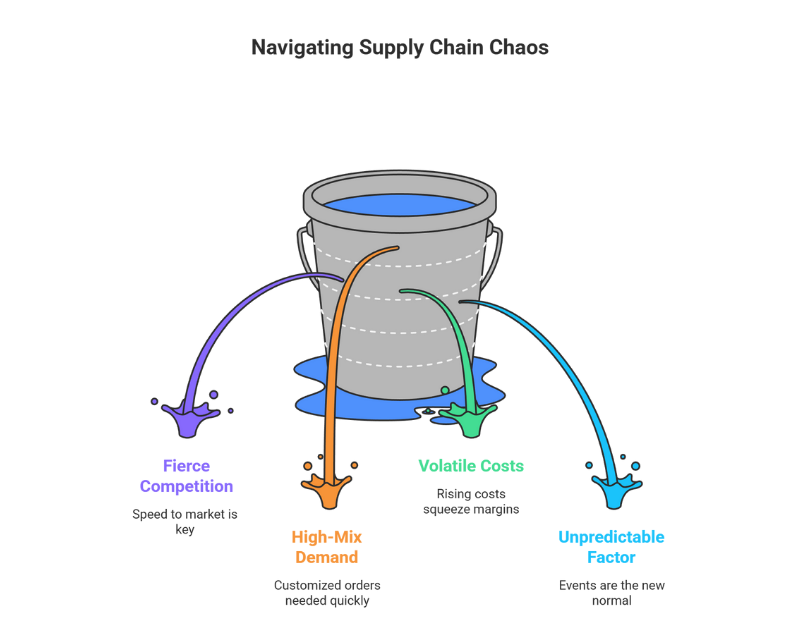
Today’s managers and executives are facing a “perfect storm” of operational challenges. According to our research and feedback from the industry, the supply chain landscape is currently being impacted by:
- Fierce Market Competition: Speed to market is now a primary differentiator.
- High-Mix, Low-Volume Demand: Customers want specific, customized orders delivered yesterday, especially with the growth of e-commerce.
- Volatile Costs: Rising material, manufacturing, and transportation costs are squeezing margins.
- The “Unpredictable” Factor: From global pandemics to geopolitical shifts, unpredictable events are the “new normal.”
To survive these challenges, businesses must transition from reactive firefighting to proactive warehouse leadership training. It is no longer enough to just “manage” a storage space; leaders must optimize the inventory, resources and tools within the broader Supply Chain Network.
The North Star: The 6 “RIGHTs” of SCM
At the heart of our warehouse and inventory management training is a fundamental framework that guides every decision on the floor. To achieve excellence, a warehouse must consistently deliver the:
- Right Product
- Right Quantities
- Right Place
- Right Time
- Right Quality
- Right Costs
Failure in even one of these “RIGHTs” impacts the entire organization. A mistake in “Right Quantities” leads to inventory bloat or stockouts; a failure in “Right Time” results in penalized late fees and lost customer trust.
From Storage Space to Value-Added Hub
The most successful organizations today view their warehouse as a Value-Added Hub. Within the supply chain network—linking suppliers, manufacturers, and the end customer—the warehouse is the final checkpoint for quality and efficiency.
However, achieving this level of operational maturity requires more than just new software or faster forklifts. It requires a shift in mindset. This is why warehouse operations training is moving away from purely technical skills and toward strategic leadership.
Executives must ask themselves: Is my warehouse team equipped to handle high-mix demand? Do my supervisors understand how inventory costs affect our bottom line?
The Path Forward: Leadership as the Catalyst
Optimization happens at the intersection of People and Process. While automation and technology are vital, they are only as effective as the people operating them.
Investing in warehouse supervisor training courses ensures that your front-line leaders aren’t just watching the clock, but are actively identifying waste (such as the “TIMWOODS” wastes of motion and over-processing) and driving continuous improvement.
In the following sections of this guide, we will break down the specific operational tactics—from receiving and putaway to advanced inventory counting—that turn these strategic goals into daily reality.
The Foundation: Mastering Basic Warehouse Operations for Maximum Flow
If the supply chain is the circulatory system of a business, the warehouse is the heart. For executives and managers, “foundational” doesn’t mean “simple”—it means “critical.” A breakdown in basic operations leads to a “clogged” system, resulting in delayed shipments, damaged goods, and inflated labor costs.
Mastering these core operations is the primary goal of any effective warehouse and inventory management training program.
1. The Critical Start: Receiving and Putaway
Efficiency begins the moment a truck comes into the receiving bay. Many operational issues that trouble warehouses—such as “lost” inventory or shipping errors—actually originate during the receiving phase.
- Receiving: This is the “gatekeeper” function. It requires strict adherence to good warehousing practices (GWP) to ensure that the quantity and quality of incoming goods match the purchase orders.
- Putaway: Once received, the speed and logic of putaway dictate the efficiency of the entire facility. Optimal putaway involves placing items in the “right” and practical locations based on turnover rate (eg. fast-moving items closer to the issuance or shipping area).
2. The Fulfillment Engine: Picking and Packing
Picking and packing are typically the most labor-intensive activities in a warehouse, often accounting for over 50% of total operating costs.
- Picking Strategies: Whether your team uses “zone picking,” “wave picking,” or “batch picking,” the goal is the same: minimizing travel time. In our warehouse management training courses, we emphasize that “motion” is a form of waste. If a picker is walking long distances, you are losing money.
- Packing Excellence: This is the final touchpoint before a product reaches the customer. Proper packing isn’t just about protection; it’s about optimizing dimensional weight to reduce transportation costs—the “Right Costs” pillar of SCM.
3. Infrastructure: Storage Shelving and Materials Handling
A warehouse’s physical layout directly impacts its throughput. Managers must view their infrastructure not as static furniture, but as dynamic tools for efficiency.
- Storage Shelving: From pallet racking to mezzanine systems, the choice of shelving should maximize “cube utilization” (using the full height of the building) while ensuring safety and accessibility.
- Materials Handling Equipment (MHE): Choosing the right forklift, reach truck, or conveyor system is a balancing act between capital investment and operational speed. Our training helps leaders evaluate which equipment provides the best ROI for their specific volume and product mix.
4. Improving Work Methods and Efficiency
A warehouse consists of a collection of work methods. Optimization occurs when you stop “working harder” and start “working smarter.” Effective warehouse operations training focuses on standardizing these methods to reduce variability. By establishing “Standard Operating Procedures” (SOPs) for every task—from how a pallet is wrapped to how a return is processed—you create a baseline for continuous improvement. This is where we begin to introduce the concepts of Lean Warehousing, identifying bottlenecks before they become backlogs.
Summary: The Foundation of Excellence
Understanding these basics allows a manager to move from “firefighting” daily crises to “orchestrating” a smooth flow of goods. When the foundations of Receiving, Putaway, Picking, and Packing are solid, the organization is ready to tackle the more complex challenges of inventory management and leadership optimization.
Inventory Management Mastery: Balancing Availability and Capital Efficiency
For many organizations, inventory is the largest asset on the balance sheet—and the largest potential liability. Mastery of warehouse inventory management training is not just about knowing what is on the shelves; it is about optimizing the delicate balance between having enough stock to meet customer demand and minimizing the capital tied up in “dead” or slow-moving goods.
The Strategic “Why” of Inventory
Before we can manage inventory, we must understand its role in the supply chain. Businesses keep inventory for several strategic reasons:
- Synchronization: Allowing different parts of the supply chain to operate at different speeds and yet in sync with the master plan.
- Protection: Buffering against the “unpredictable events” mentioned in our introduction (e.g., supplier delays or sudden demand spikes).
- Economics: Taking advantage of bulk purchase discounts or reducing transportation costs.
However, every item sitting in your warehouse carries a cost. Our inventory management training teaches managers to look beyond the purchase price and consider the carrying costs, which include storage space, insurance, taxes, and the risk of obsolescence or damage.
The Financial Impact: Inventory as Working Capital
To an executive, inventory is “frozen cash.” If your inventory isn’t moving, your cash isn’t working. Effective warehouse and inventory management training focuses on improving Inventory Turnover Ratios.
By aligning your inventory levels with the 6 “RIGHTs” of SCM—specifically the Right Quantities and Right Costs—you free up working capital that can be reinvested into business growth, R&D, or marketing.
Achieving 100% Accuracy: The Art of the Inventory Count
Data is only useful if it is accurate. A Warehouse Management System (WMS) is only as good as the physical reality on the floor. Discrepancies between the “system” and the “shelf” lead to missed sales, over-ordering, and operational chaos.
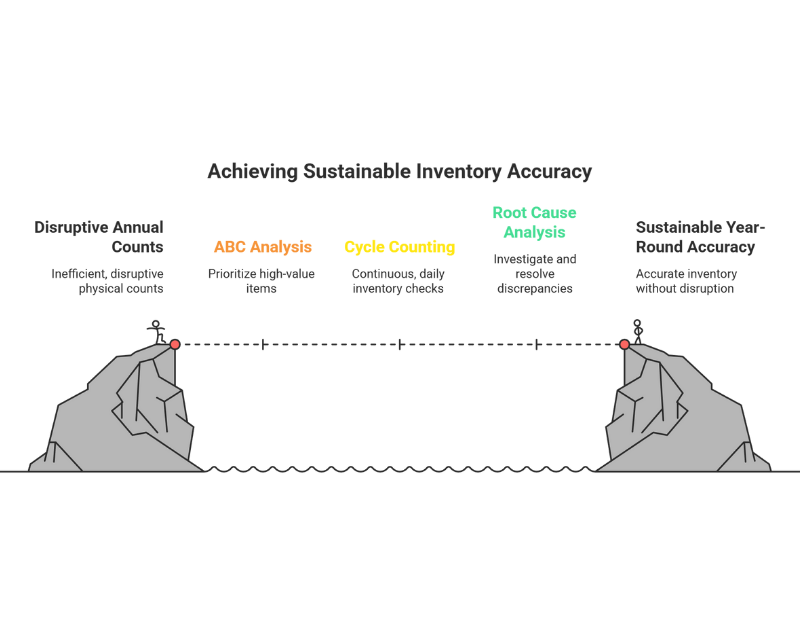
- ABC Analysis: Focusing the most intense counting efforts on your “Category A” items—the 20% of products that typically represent 80% of your value.
- Cycle Counting: A continuous process of counting a small subset of inventory every day. This ensures high accuracy year-round without stopping operations.
- Root Cause Analysis: When a discrepancy is found, we don’t just “adjust the system.” We find out why it happened. Was it a receiving error? A picking mistake? Or a system lag?
This is where inventory count training becomes a competitive advantage. We move teams away from disruptive, once-a-year “wall-to-wall” physical counts toward more sustainable practices:
Integrating Inventory with the Broad Supply Chain
Mastery doesn’t happen in a vacuum. Your warehouse inventory levels are a direct result of your relationships with Suppliers and your understanding of your Customers. By practicing better inventory counts and data collection, you provide the “Manufacturer” and “Purchasing” teams with the insights they need to make better buying decisions. This integration is the hallmark of a mature, high-performing supply chain.
The Human Element: Leadership and Workforce Optimization
In the quest for a high-performance warehouse, it is easy to become hyper-focused on software and automation. However, we believe that true warehouse optimization occurs at the intersection of two critical pillars: People and Process. Technology is a tool, but your workforce is the engine that drives it.
Warehouse Leadership: The Bridge Between Strategy and Execution
The most sophisticated supply chain strategy will fail if it cannot be executed effectively on the warehouse floor. This is why warehouse leadership training is no longer optional—it is a strategic necessity.
Supervisors and managers are the “operational glue” of your business. They are responsible for converting executive goals into daily tasks while maintaining morale and safety of your team. Effective warehouse supervisor training courses empower these leaders to:
- Identify Bottlenecks: Recognizing when a process is failing in real-time.
- Coach Performance: Moving beyond simple oversight to active mentorship of the floor team.
- Drive Continuous Improvement: Encouraging a culture where every employee feels empowered to suggest efficiencies.
Addressing the “Skills” Waste (TIMWOODS)
In our training, we utilize the TIMWOODS framework to identify the eight types of waste that drain warehouse profitability. While most managers recognize “Transport” or “Inventory” waste, the final “S”—Skills—is often overlooked.
Skills Waste occurs when an organization fails to utilize the full potential, knowledge, and talents of its people. This can manifest as:
- Employees who are over-qualified for their current tasks.
- A lack of cross-training, leading to operational “shutdown” when a key staff member is absent.
- Front-line workers who see inefficiencies but lack the training or platform to tackle them.
By investing in comprehensive training for warehouse employees, you eliminate this waste, turning your workforce into a proactive asset rather than a passive labor cost.
Cultivating a Culture of Problem Solving
A world-class warehouse isn’t one that never has problems; it’s one where problems are solved at the source, quickly and permanently. Our training focuses heavily on problem-solving in warehouse operations.
We teach supervisors how to move away from “temporary fixes” (band-aids) and toward root-cause analysis. When your team is trained to ask “Why?” instead of just “Who?”, you create a resilient operation that improves itself every single day.
Lean Warehousing & Continuous Improvement — Driving Long-Term Operational Excellence
In a modern supply chain, efficiency isn’t just about speed; it is about the continuous elimination of waste. Lean warehousing is a strategic approach that transforms the warehouse from a traditional storage space into a high-turnover, value-driven hub. For executives, this means shifting the focus from “doing more” to “achieving more” by optimizing every movement and process within the facility.
Eliminating Waste with the TIMWOODS Framework
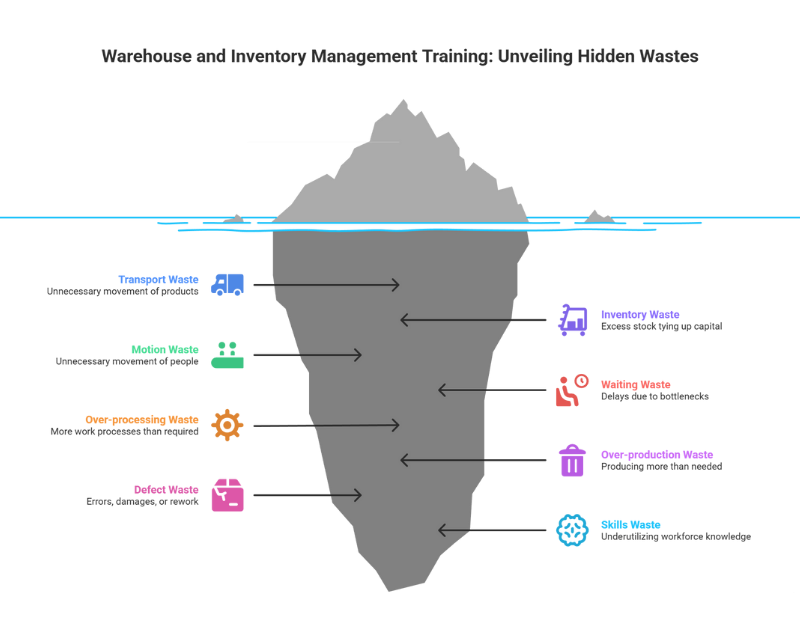
At the heart of warehouse and inventory management training is the ability to identify and eliminate “waste”—any activity that consumes resources but adds no value to the customer. We use the TIMWOODS framework to help managers and supervisors spot these hidden costs on the floor:
- Transport: Unnecessary movement of products or materials.
- Inventory: Excess stock that ties up capital and occupies valuable space.
- Motion: Unnecessary movement of people (e.g., pickers walking inefficient aisles).
- Waiting: Delays due to upstream bottlenecks or system downtime.
- Over-processing: Performing more work processes than is required by the customer.
- Over-production: Producing or processing more than is needed for the next step.
- Defect: Errors, damages, or rework that increase operational costs.
- Skills: The waste of underutilizing the knowledge and talents of your workforce.
By training your team to see the “wastes”, you empower them to proactively reduce costs and improve the overall flow of operations.
The 5S Framework: A Foundation for Stability
To sustain continuous improvement, a warehouse must be organized, clean, and disciplined. Our warehouse operations training includes deep dives into the 5S methodology, which provides a structured approach to workplace organization:
- Sort: Develop a proper system to segregate what’s necessary and not to optimize the warehouse space.
- Set in Order: Organize necessary items so they are easy to find and use.
- Shine: Clean the area and equipment to identify potential issues early.
- Standardize: Create consistent procedures to maintain the first three S’s.
- Sustain: Build the system and discipline to follow the standards every day.
Implementing and sustaining 5S isn’t just about housekeeping; it is a critical safety and efficiency standard that reduces search time, prevents accidents, and boosts work quality and employee morale.
A Culture of Problem Solving
Continuous improvement is only possible when a team is equipped with the right problem-solving mindset. Synerflex Consulting’s approach to problem-solving in warehouse operations teaches supervisors and leaders how to move beyond “quick fixes”. We focus on:
- Root Cause Analysis: Identifying why a problem occurred rather than just treating the symptom.
- Data-Driven Decisions: Using warehouse metrics and KPIs to guide improvement efforts.
- Incremental Gains: Encouraging small, daily improvements that compound into massive operational shifts over time.
Summary: The Path to Operational Agility
Lean warehousing is not a one-time project; it is a commitment to excellence. By combining the TIMWOODS waste identification with the 5S framework and a robust problem-solving culture, your organization can achieve the operational agility required to thrive in today’s unpredictable market.